
The home is more than just a physical space to the individuals with autism spectrum disorders or their families. It is a primary means to wellness, refuge from sensory bombardment, and pathways to autonomy.
The practice in the designing of homes to be autism-friendly “is a form of empathic architecture and interior design in the service of designing spaces to be more predictable, safe, and in keeping with special sensory needs. It is an all-encompassing guide to the principles and application in the practice to transform a living room to a home to be of help.”
Autism Spectrum Disorder (ASD) is described as a variety of experiences, but one similarity is an abnormal sensory processing. This may include hypersensitivity in which case lights are too bright, sound is too loud and the feel of things is overpowering. On the other hand, it may be accompanied by a state of hyposensitivity, which requires more extreme senses to be regulated. A home environment which is usually full of unpredictable stimuli may thus be a reason for tremendous stress or dysregulation.
As it is stressed in one of the key articles by the University of Florida, the main philosophy of an autism-friendly design is the ability to give choices. An effective home is not a one-dimensional perception of the senses but a topography of choices. It must provide areas of stimulation and areas of withdrawal, which will enable the person to seek the setting he or she requires to self-regulate at a particular point of time.
This is the foundation which cannot be compromised. It includes locking windows and doors to avoid elopement, having tamper resistant power outlets, fastening heavy furniture onto the wall and providing intelligent storage of dangerous objects. Such organizations as the Autism Society offer powerful safety kits on the home.
Visual clutter and chaotic layouts breed anxiety. An autistic friendly house has an advantage of predictability because of a clear line of sight, with regular positions of furniture and determined areas. Visual aids such as labeled bins, picture schedules with steps of a morning routine or color-coded calendar help to make the world a place of easier navigation and comprehension.
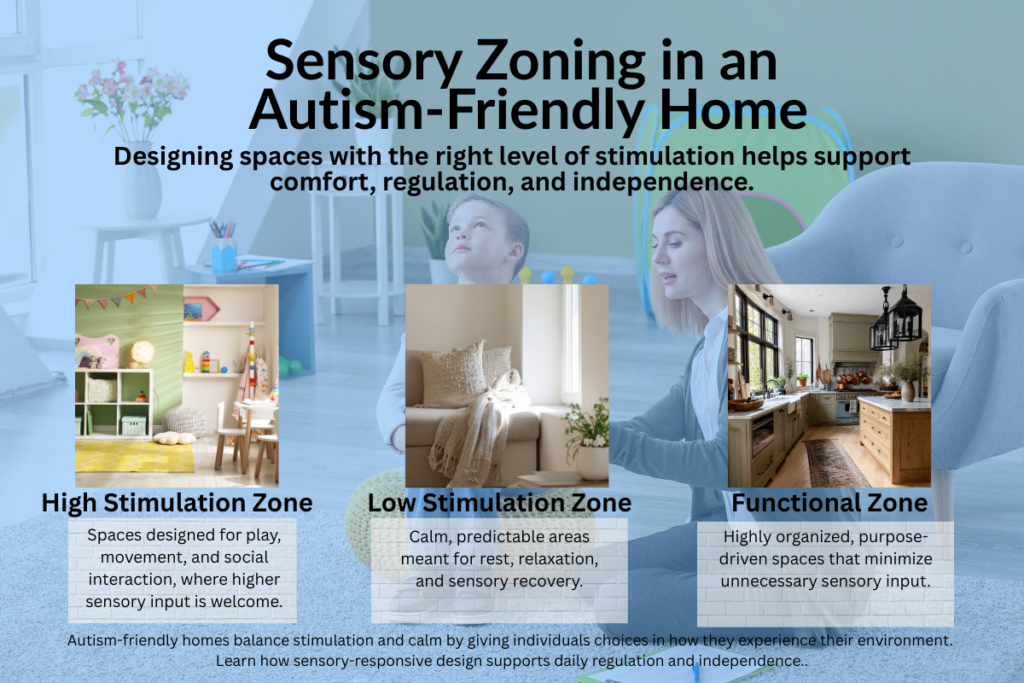
Each room cannot possess the same sensory volume. The intentional zoning forms a rhythm in itself in the house:
It does not have a standardized checklist. The designs that come out as the most successful are through observation and consulting the autistic person. One person might experience a calming effect with one type of texture and be irritated by another; one person may love deep pressure massage and another may feel constrained.
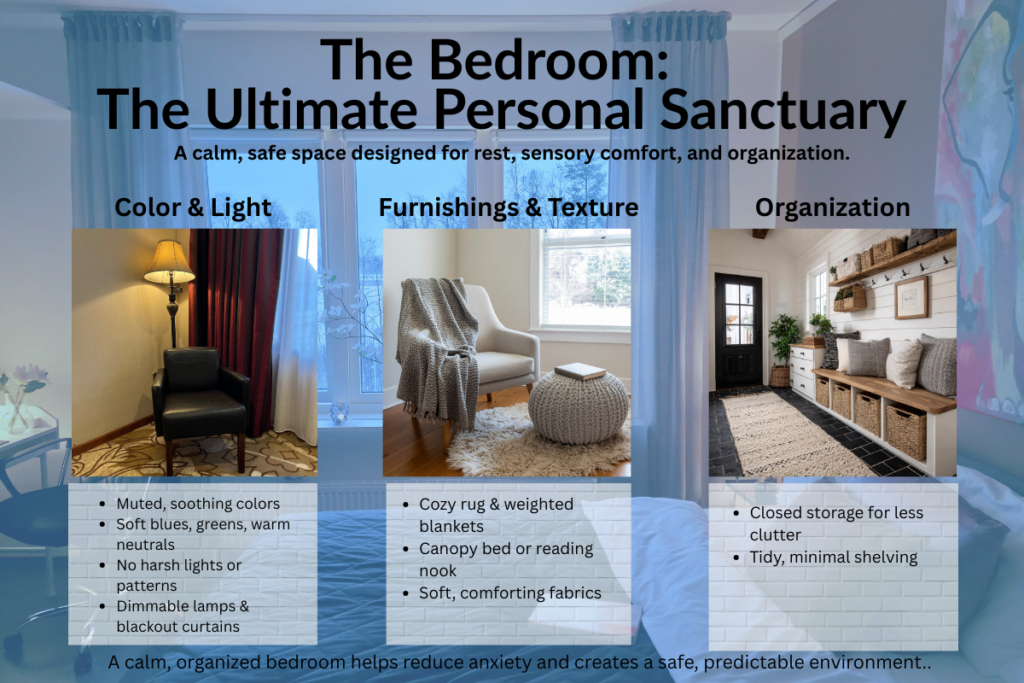
This is a room which should be a dependable place of rest and control.
Color and Light:
Opt for a muted, monochromatic color palette. The neutral warm colors, soft blues, greens, grays, and warm neutral colors will be mostly relaxing, though high-contrast patterns and vivid colors are to be avoided.
In a study identified by Autism Speaks, it was observed that environmental modifications may be a major influence on behavior and anxiety as discussed in their guide book on the environment. Then, no more fluorescent, but dimmable LEDs, blackout coverings, and indirect sources such as floor lamps.
Furnishings and Textures:
Add fabric that is comfortable and offers the required sensory response. This may be a cushy floor covering, a soft weight blanket or blackout curtains that have a pleasing meter. Such furniture as a canopy bed, a tent, or a high-backed reading chair can produce a desirable feeling of enclosed safety.
Organization:
Store in closed storage (drawers, door-opening cabinets) to reduce the amount of visual clutter. In case there is open shelving, they should be well arranged without overloading it.
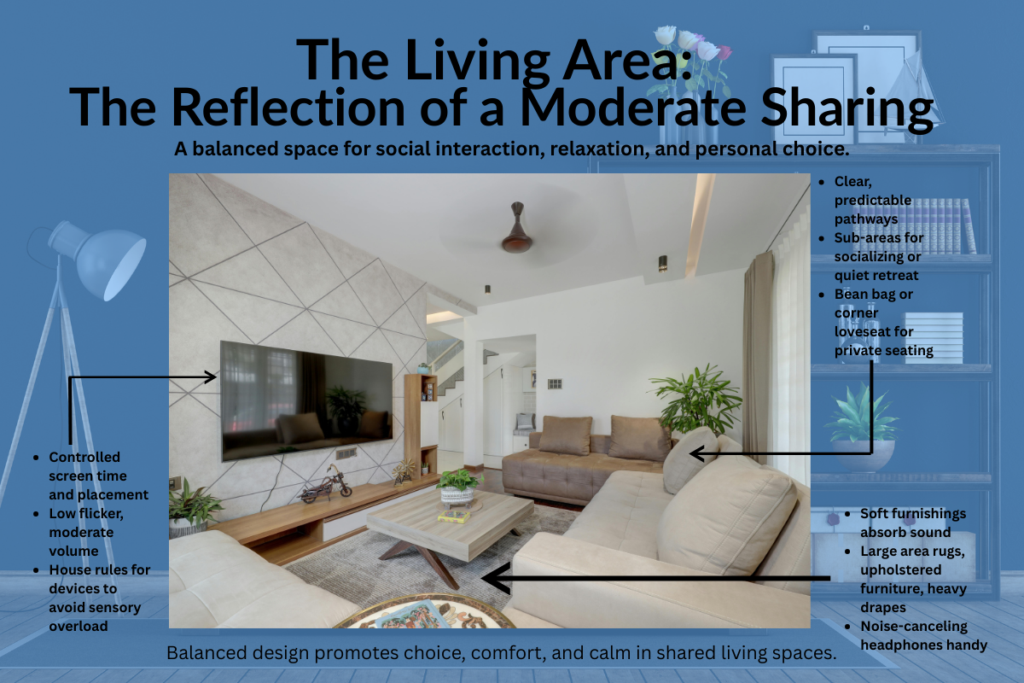
This community center should be able to strike equilibrium between family life and the sensory requirements.
Acoustic Management:
Soft materials are your ally. The presence of large area rugs, furniture upholstered, heavy drapes, and wall acoustic panels can be very dramatic in absorbing the echo and reducing noise. Always keep noise canceling headphones ready in a special place.
Furniture Arrangement:
Create clear, predictable pathways and define sub-areas. Arrange the seating to provide not only social interaction but also choice of whether to face away or not. An in-room retreat can be a huge bean bag chair or loveseat set up in a corner with no one passing by. A large bean bag chair or a loveseat tucked into a quiet corner can serve as an in room retreat.
Technology and Visuals:
Control the amount of time and location allocation of screens to prevent the multiple and competing sources of flickering light. Set up house regulations on the volume.
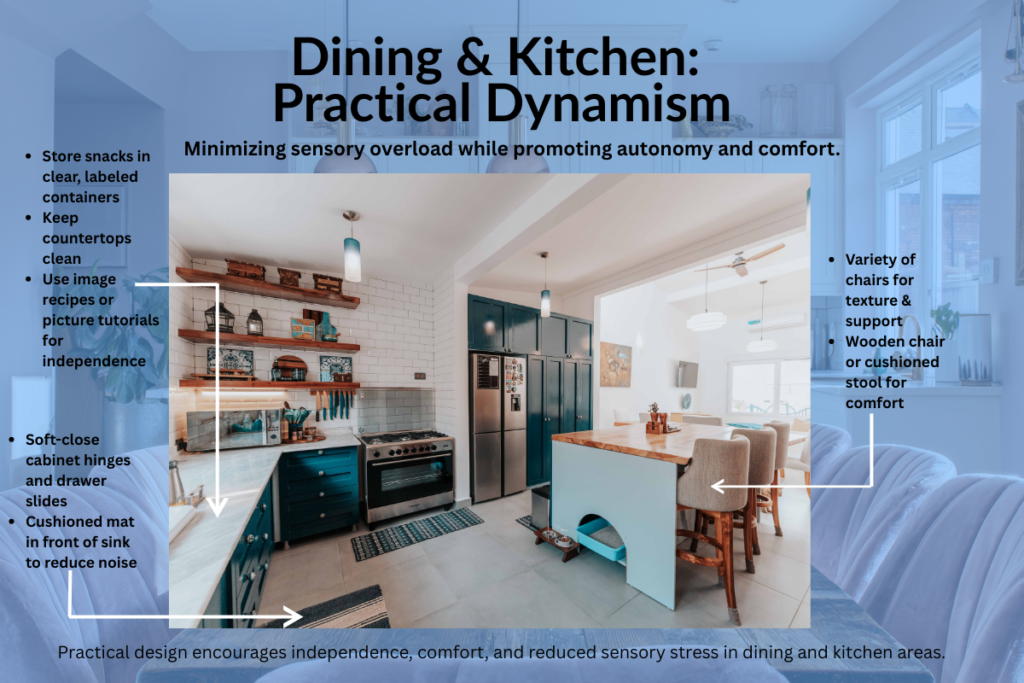
This is aimed at minimizing over-saturation and encouraging autonomy.
Cleaning and Procedure:
Store snacks and pantry in clear labelled containers. Clean the counter tops as much as possible. An image recipe or a picture tutorial on how to prepare a simple meal can create independence and lower the anxiety level toward activities.
Sensory Buffers:
Fit cabinet hinges and drawer slides that have soft-close properties to avoid banging doors. The cushioned mat in front of the sink may also create comfort and sound damping.
Seating Choices:
Have a variety of seating arrangements where there is variety in the textures and supportiveness. Others could feel very comfortable on a wooden chair with its solidness, whereas other people might need the deep support of a cushioned stool.
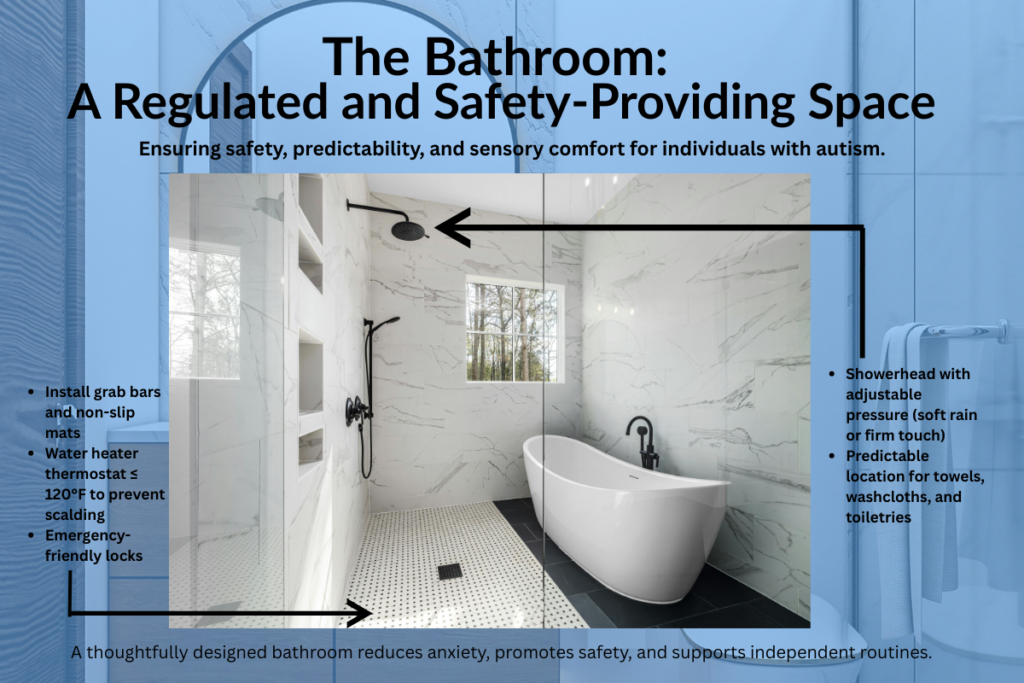
Bathrooms have special sensory issues (water, temperature, sounds) and safety problems.
Keep it Safe:
This will prevent scalding by installing grab bars, non-slip mats, and setting the thermostat of the water heater to not more than 120°F. Take an example of a lock that can be forced open in an emergency.
Sensory Control:
A showerhead that has pressure control features is priceless. There are those who would be content with the soft rain effect, and those who would want a firmer touch. Keep towels, washcloths and toiletries in regular predictable locations.
In addition to thinking in terms of adjustments within an individual room, consider setting up a “room,” or an area midway in size between a whole room and a single corner, as a “sensory integration zone.” This type of zone is anticipative in terms of self-regulation.
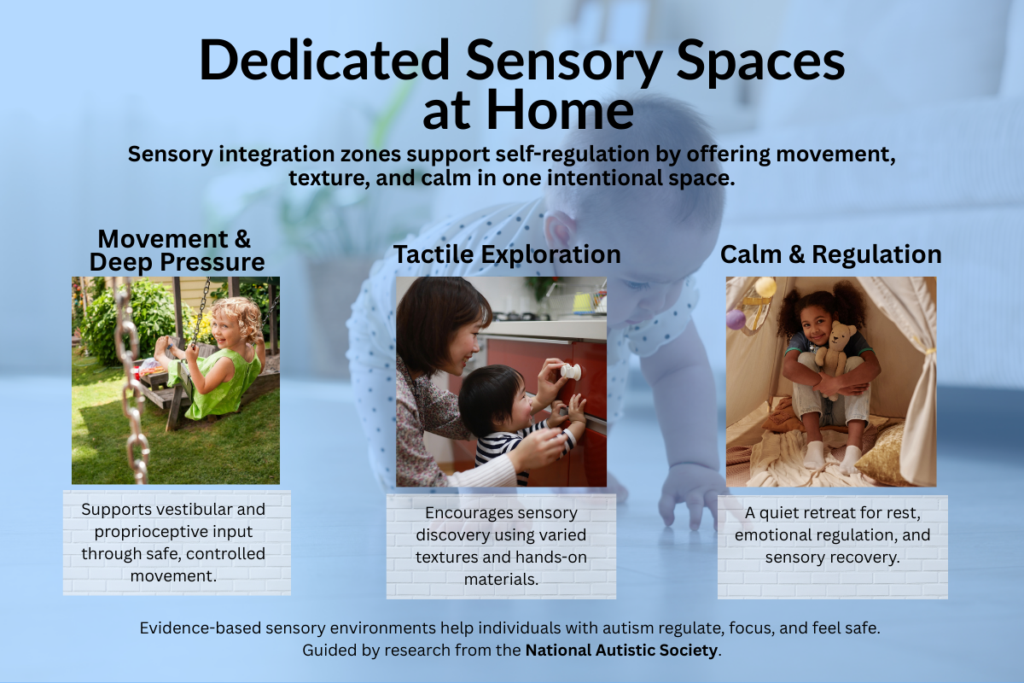
To elaborate on how to make sensory rooms effective, the National Autistic Society has an excellent and evidence-based guideline on its resource on the National Autistic Society: Sensory Environments.
The creation of an autism-friendly home is not a one-dimensional project, but the continuous cooperation with people who live in it. Needs will fluctuate and space ought to change. As often as possible, seek feedback, see what works and what is stressful, and be ready to change things. The final objective is to establish a base of security on which one can develop and interact with the world on personal terms.
With all these principles of safety, predictability, sensory zoning, and personalization, you leave the realm of design and create an actual haven. The healthy atmosphere removes anxiety, enhances confidence, develops skills and offers the healing silence needed in a satisfying life.
To gain an expanded view on inclusive design to the benefit of all neurological profiles, one may refer to the principles which are presented by the Center for Universal Design in The Principles of Universal Design.
References: