
The rate of homelessness in the older adult population is steadily increasing throughout the United States, which presents an increasing and severe necessity of emergency housing alternatives catering to the needs of older adults. A set of factors including increased rental costs, inflation, lack of affordable housing, medical spending, and accessibility to federal purposes of assistance, are increasingly leaving seniors vulnerable to the instability of housing. To most elderly individuals, any financial crisis like a health crisis or a rise in rental price can push them to homelessness.
Simultaneously, the federal government has started to reduce various vital housing and healthcare initiatives which low-income seniors rely on. The changes are likely to cause an additional burden to already constrained emergency housing resources in the future. Emergency housing is a short-term yet critical measure which offers a safe shelter and stability to the seniors and the other low-income people who are homeless.
Although emergency housing is not intended to be long-term, it has a vital role to play in ensuring vulnerable groups are secured and linked to long-term housings and services.
By 2025, America recorded the highest rates of homelessness in history and it is not showing signs of diminishing. The article published by the National Alliance to End Homelessness in 2025 states that the number of homeless people in America has increased by 18% within one year, with 653,104 in 2023 and 771,480 individuals in 2024 being the number of homeless in the country.
A big part of this growth has been in the older adults. According to reporting by NPR, this trend has been termed a gray wave of homelessness that has been mainly caused by inflation, increased housing prices and lack of affordable and accessible housing among the elderly citizens especially those living with disabilities or chronic illnesses. Most adults are aged and receive fixed incomes that fail to keep up with the rent prices, thus struggling to stay in a place to live.
More difficulties are anticipated in 2026 with changes in federal policy starting to be implemented. The reduction in housing aid and healthcare services under the Trump administration will impact more elderly citizens and those particularly, who depend on the Medicaid and federal rental assistance programs. Such cuts can restrict an access to emergency housing as well as affordable long-term accommodations.
The facts presented by the National Low Income Housing Coalition also demonstrate the extent of the issue, revealing that there is not a single state in the U.S. that provides low-income renters with an adequate amount of affordable housing. Consequently, older adults in the entire nation face the risk of homelessness.
More older adults are being served by shelters, and chronic homelessness rates in seniors have been increasing. Even though the government assistance has been increased to meet the challenges, it has not been adequately enough to match the demand with needs particularly the older adults in need of emergency shelter.
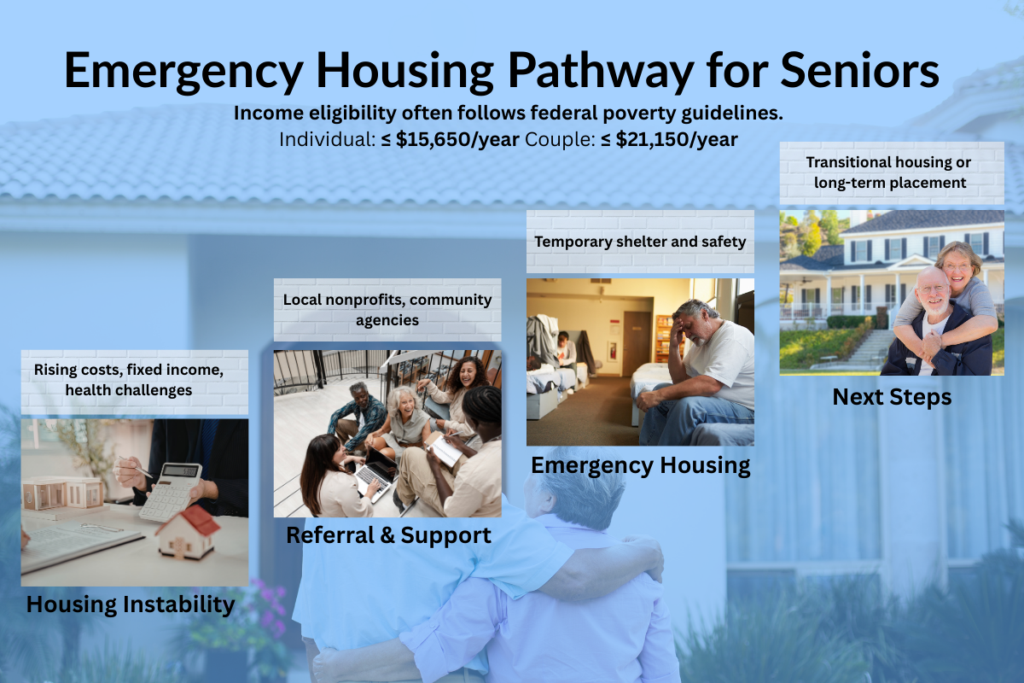
Emergency homeless assistance is also termed as emergency housing and it offers temporary accommodations to homeless persons or those who are at risk of losing their homes. The programs will provide short-term safety and stability as people seek longer-term accommodation.
In the case of seniors, emergency housing offers temporary solutions to unsafe environments, exposures to the weather, and the physical and psychological burdens of being homeless. The local governments, nonprofit groups, faith groups, and community agencies normally run the emergency housing programs.
The eligibility requirements depend on the state and the program, however, most emergency housing programs use the federal poverty standards as a guide in determining the level of income eligibility. In 2025:
Local nonprofits often refer seniors to emergency shelters, transitional housing or temporary housing when they can no longer safely afford or sustain their housing.
The majority of cities and counties provide local emergency housing services, and some of the nationwide organizations assist seniors in finding a quick solution. The internet can be the quickest method of the available housing options, and the public libraries offer free internet access to people who lack computers and Wi-Fi.
The following are the most prevalent programs among the seniors requesting emergency housing.
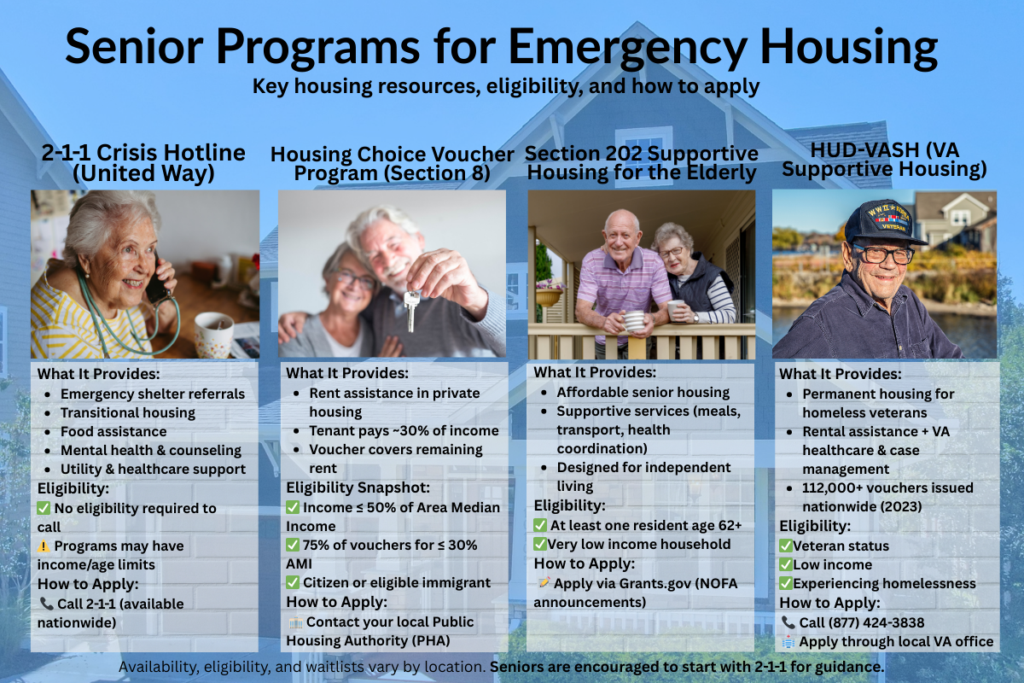
One of the most significant points of entry of seniors facing housing instability is the 2-1-1 Crisis Hotline, which is operated in collaboration with United Way. Seniors can call 2-1-1 in order to get referrals to emergency shelters, transitional housing programs and other vital support services.
In addition to housing referrals, 2-1-1 connects seniors with:
Making a call to 2-1-1 is a conditioned prerequisite to receiving emergency shelters and other housing support services.
Eligibility Information
Application Information
Section 8, or the Housing Choice Voucher Program, offers housing services to low-income families, people with disabilities, and seniors. Housing vouchers are distributed by local Public Housing Authorities (PHAs).
This program gives participants the freedom to select their own lodging in the private rental market provided the unit fits the program requirements. The participants normally pay one-third of their monthly adjusted income to rent, with the voucher paying the rest.
Budget proposals to be implemented in 2026 would cut down funding of this program considerably. The proposal involves a 51 percent cut in the HUD funds which would transfer the responsibility of the rental assistance to the state block grants. These modifications may restrict the use of vouchers among the elderly in the future.
Eligibility Information
Application Information
Section 202 Supportive Housing for the Elderly Program increases the number of affordable housing units offered to the elderly and avails supportive services. These services could be housekeeping services, transportation services, meal assistance, and health coordination services.
Section 202 housing aims at assisting seniors to stay independent and in a safe and affordable living environment. The housing of this type is highly demanded and a waiting list is a common occurrence in the country. With the changes proposed in the budget of 2026, the program will be administered at the state level, as opposed to the federal government level.
Eligibility Information
Application Information
HUD-VASH program gives permanent housing to the homeless veterans. The program is a combination of rental aid under HUD with case management and medical care administered by the Department of Veterans Affairs.
By December 2023, nearly 112,000 HUD-VASH vouchers had been allocated nationwide. Besides housing assistance, VA case managers assist veterans to receive medical care, mental health and substance use treatment.
Eligibility Information
Application Information
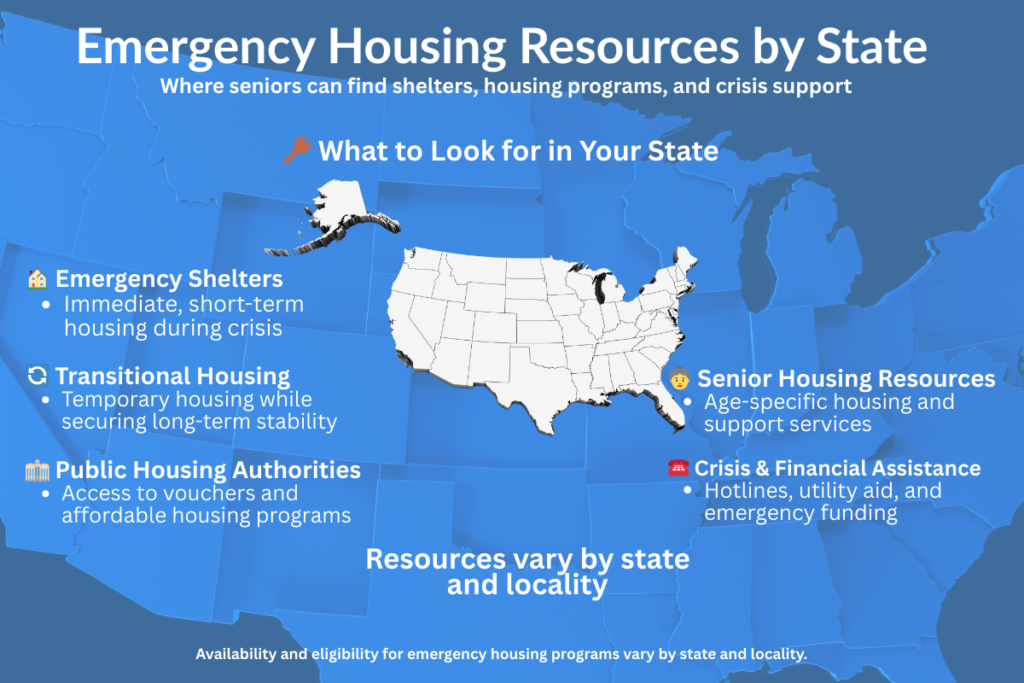
The availability of emergency housing depends on state and locality. The seniors may use state-specific resource maps and directories to find:
Using state-based tools can help seniors and caregivers identify the most appropriate options quickly.
The timeline is dependent on the location and availability. The most common first step would be to call 2-1-1. Veterans are also advised to call VA hotline (877) 424-3838. Placement in shelters is often faster than the long-term housing program approval.
Yes. The length of stay in emergency shelter depends on the program and need with some shelters providing various months of stay. Section 202 supportive housing has no time constraints, yet waiting lists may take several years.
Yes. Counties have emergency financial aid programs to allow seniors to cope with utility shut offs, home repairs or temporary financial problems. Such programs can assist senior citizens to shift scarce finances into rent or mortgage payments. The best place to start may be calling 2-1-1.
When an elderly loses financial resources, the housing instability can rapidly increase. Seniors that are not in the nursing homes, assisted living centers or independent living communities can be left with little immediate choices. Emergency housing is a very important safety net as it also helps them to have a stable and safe shelter and access to supportive services.
Crisis hotlines, nonprofit organizations, and public housing agencies are significant in assisting seniors to deal with housing emergencies. An early action and reaching numerous resources may have a beneficial effect on the likelihood of finding help.